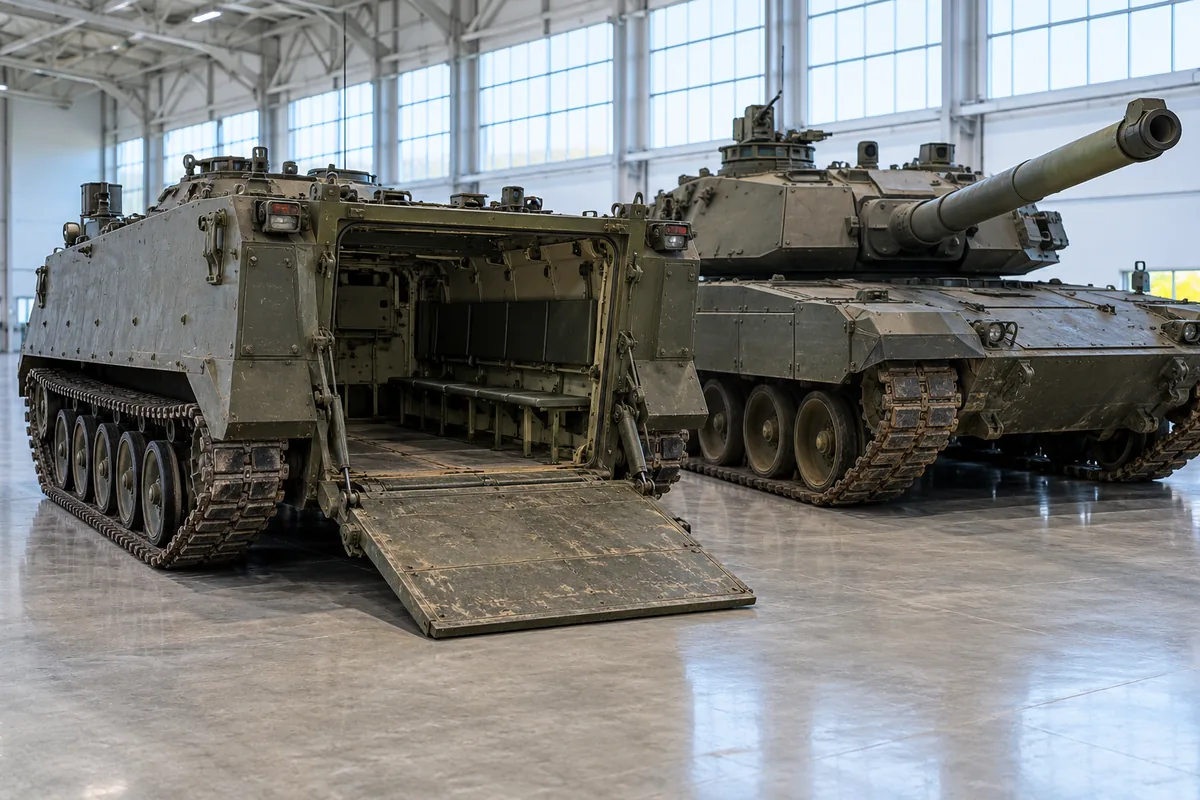
Is a Bradley a Tank? How to Tell Tanks, IFVs and APCs Apart
The short answer: No. The M2 Bradley is an infantry fighting vehicle (IFV), not a tank. It has tracks, armor and a turret, so it looks like one, but its main job is to carry a squad of soldiers into battle and support them with a 25mm cannon and anti-tank missiles. A tank is built around a big main gun and carries no passengers. An armored personnel carrier (APC) carries soldiers too, but with little more than a machine gun.
Almost every armored vehicle on tracks gets called a “tank” in news stories, video games and family photos. This guide explains what actually separates the three classes, gives you a four-question checklist you can use in front of any vehicle, and points to examples of each that are part of the collection at the Tucson Military Vehicle Museum.
What Makes a Tank a Tank
A tank is designed to fight other armored vehicles head-on. Everything about it serves its main gun: heavy armor, a fully rotating turret, and a crew whose only job is to drive, load, aim and command. There is no room for passengers.
The clearest formal definition comes from the 1990 Treaty on Conventional Armed Forces in Europe (CFE Treaty), which had to count tanks precisely. It describes a battle tank as an armored fighting vehicle with high firepower, “primarily of a high muzzle velocity direct fire main gun,” that weighs at least 16.5 metric tonnes unladen and carries a gun of at least 75mm that can turn 360 degrees. It also states that a tank is not designed and equipped primarily to transport combat troops.
The M1A1 Abrams in the museum’s collection fits every line of that definition: a 120mm smoothbore main gun, a crew of four, and a combat weight of about 67.6 tons. The older M60A1 (105mm gun, crew of four) and the Soviet T-62 (115mm gun) are built on the same idea.
What an Armored Personnel Carrier (APC) Does
An APC is an armored bus for infantry. It moves a squad across the battlefield under protection from small-arms fire and shell fragments, then the soldiers climb out and fight on foot. The CFE Treaty defines it as a vehicle “designed and equipped to transport a combat infantry squad,” “as a rule” armed with a weapon smaller than 20mm.
The M113 armored personnel carrier is the classic example. It entered U.S. Army service in 1960 with a crew of just two, room for 11 to 15 passengers, and a single .50-caliber machine gun. Its aluminum hull kept it light enough to be carried by C-130 transport planes. The museum’s M59, which the M113 replaced, followed the same formula with seating for 10.
This approach is often called the “battle taxi”: the vehicle delivered troops and then pulled back, because it was never meant to slug it out with enemy armor.
What an Infantry Fighting Vehicle (IFV) Adds
An IFV still carries a squad, but it is built to fight alongside tanks rather than drop soldiers off and leave. The CFE Treaty describes it as a troop carrier armed with a cannon of at least 20mm, sometimes with an anti-tank missile launcher, that “normally provides the capability for the troops to deliver fire from inside the vehicle under armoured protection.”
The Soviet Union fielded the first mass-produced IFV, the Soviet BMP-1, in 1966. It carried three crew and eight passengers, a 73mm gun and a wire-guided anti-tank missile. The idea was to let infantry keep pace with tanks and stay protected inside, even on a battlefield contaminated by nuclear or chemical weapons.
The United States answered with the M2 Bradley, named after World War II General Omar Bradley. It entered service in 1981 with a crew of three plus six soldiers, a 25mm M242 chain gun and a twin TOW anti-tank missile launcher. It was designed to be fast enough to keep formation with the new M1 Abrams, something the slower M113 could not do.
That firepower is why people call the Bradley a tank. During the debate about sending Bradleys to Ukraine, Task & Purpose explained that its 25mm gun is far too small for the tank category, and that Bradleys are crewed by the Army’s infantry branch, while tanks belong to the armor branch.
Tank vs IFV vs APC at a Glance
| Tank | Infantry fighting vehicle (IFV) | Armored personnel carrier (APC) | |
|---|---|---|---|
| Main job | Destroy enemy armor and strongpoints | Carry infantry and fight alongside tanks | Carry infantry to the fight |
| Passengers | None | Often 6 to 8 (Bradley 6, BMP-1 8) | Often 10 or more (M113 11 to 15) |
| Main weapon | Large gun, 75mm or more (105-125mm on modern tanks) | Cannon of 20mm or more, often with anti-tank missiles | Machine gun under 20mm |
| Armor | Heaviest | Medium | Lighter |
| Examples in the collection | M1A1 Abrams, M60A1, T-62 | M2 Bradley, BMP-1 | M113, M59 |
A Four-Question Spotting Checklist
Use these questions in order the next time you are standing in front of an armored vehicle, or looking at one in a photo:
- Is there a rear door or ramp for passengers? If not, and it has a turret with a big gun, you are probably looking at a tank. A large rear ramp or doors means troops ride inside.
- How big is the main gun? A long barrel of 75mm or more on a rotating turret points to a tank. A slimmer cannon, often paired with a missile launcher, points to an IFV. A machine gun on a hatch ring points to an APC.
- How tall and boxy is the hull? Carriers need headroom for passengers, so APCs and IFVs usually have a tall, box-shaped body. Tanks sit lower, with most of the height in the turret.
- Are there firing ports along the sides? Small ports or periscopes in the passenger compartment mean soldiers were meant to fight from inside, which is a strong IFV clue.
No single question settles it. Purpose is what counts, which is why the BMP-1 is an IFV even though its 73mm gun is bigger than some World War II tank guns.
Look-Alikes That Fool Almost Everyone
Some vehicles break the pattern, and they are worth knowing because they show why the categories exist.
- Tank destroyers. The M18 Hellcat has a turret and a 76mm gun, but it is a tank destroyer. It traded armor (about one inch at most) for speed, reaching around 55 mph on roads, so it could ambush tanks rather than trade blows with them.
- Tanks turned into carriers. During World War II, British and Commonwealth units pulled the turrets off obsolete Stuart light tanks and used them as “Kangaroo” personnel carriers. Same hull, completely different job.
- Reconnaissance carriers. The M114 command and reconnaissance carrier looks like a small APC, which is why “M113 vs M114” is a common search. The M114 was a low, light vehicle with a crew of three built for scouting and command, meant to work alongside the M113, not to carry a squad.
- MRAPs. Mine-resistant vehicles like the Cougar 4×4 are armored and carry troops, but they ride on wheels and use a V-shaped hull to deflect blasts from mines and roadside bombs. They were built for mounted patrols and reconnaissance in Iraq and Afghanistan, not for fighting other armor.
See the Difference Up Close in Tucson
Reading about armor only goes so far. At the Tucson Military Vehicle Museum you can walk from a main battle tank to an infantry fighting vehicle to a personnel carrier and compare hull height, gun size and rear doors for yourself. You can browse the full collection online first to pick the vehicles you want to see.
From October through May, the museum offers a 30-minute Vehicle Highlights walking tour through the main hangar, as well as a World War II tour. Tours are booked at least three days ahead and require general admission. The museum is open seven days a week, 9 AM to 5 PM from October through May, with last admission at 3 PM.
Ready to see them side by side? Plan your visit to the Tucson Military Vehicle Museum for hours, ticket prices and combo passes with Pima Air & Space Museum.
FAQ
Is a Bradley a tank?
No. The M2 Bradley is an infantry fighting vehicle. It carries six soldiers in addition to its crew of three, and its main weapon is a 25mm cannon with TOW missiles, not the large main gun that defines a tank.
What is the difference between an IFV and an APC?
Both carry infantry. An APC is mainly a protected transport with a machine gun, and the soldiers fight after they get out. An IFV carries a cannon of 20mm or more, often anti-tank missiles too, and is built to fight alongside tanks.
What is a BMP?
BMP is the Soviet family of infantry fighting vehicles. The BMP-1, introduced in 1966, was the first mass-produced IFV and pushed the United States to develop the Bradley.
Who is the Bradley named after?
General Omar Bradley, one of the senior U.S. Army commanders of World War II. The Abrams tank is named after General Creighton Abrams.